| Home | Notes | Github |
|---|
Written: 17-Sept-2025
Spoilers, I didn’t end up making this or getting it built, but here’s some quick notes on something I designed.
A paper on using blue LEDs for bleaching delicate clothes caught my fancy, and I thought it worth trying to emulate. Although my stained shirts are not delicate, they are indeed stained and this seemed easy, achievable1 and cutting edge tech apparently.
As someone with the odd stained shirt, thought it could be fun.
The initial Idea was to slap some LEDs and a cheap 5V2A
supply together and make something to test the theory. Or just do it
somewhat properly and build something with more juice and a constant
current source.
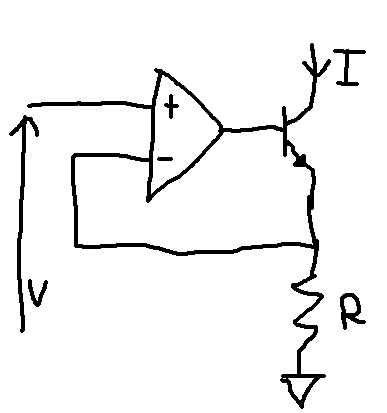
The above2 works by ensuring that the the
voltage at the top of R is the same as V. So
I=V/R. I’ve drawn a BJT here, but it works better with a
FET, so that’s what I’ve used.
I’ve a old (and redundant) laptop supply cutting about, so that could
give me a lot of juice. This will define quite how much juice I’ve got
to play with. In this case it’s 19.5V @ 3.2A.
Over 60W ⚡️ of bleaching power.
After hunting around the The LED’s I’m targeting require
350mA each, at a maximum of 3.2V
(2.8V nominal). The targeted LED is the catchily named JNJ-L-7060CW-R80W45026C1-SL-J4-F1.
Combined with the above specs this gives us 6 LEDs in series (only
gives 0.3Voverhead @ max, but 2.7V at nominal
) 8 in parallel (loads of overhead here too).
For the constant current source, the plan is to use an opamp with a
resistor and a FET to create the current source circuit.
350mA dropping 2.7V gives us a
7.7R @ ~1W. This is the upper limit of what
our sink resistor can be. The more deviation from this gives us overhead
for non-nominal LEDs.
Reducing the resistance allows us to assume more of the power is going to be dissipated over the FET. Normally this is bad, but in this instance, I’m fine with it, as for the sake of a slightly larger FET we can have lower power (and much more available) resistors.
If we assume the Resistor drops 1.75V, this gives us a
5R, 0.62W resistor. Two 10R,
0.5W resistors (e.g. this one)
will work perfectly as a substitute.
This gives us 1V to drop at nominal across the FET,
which means 350mW of power dissipated over the FET. This is
very achievable, and the BS170 seems
suitable.
This give us: 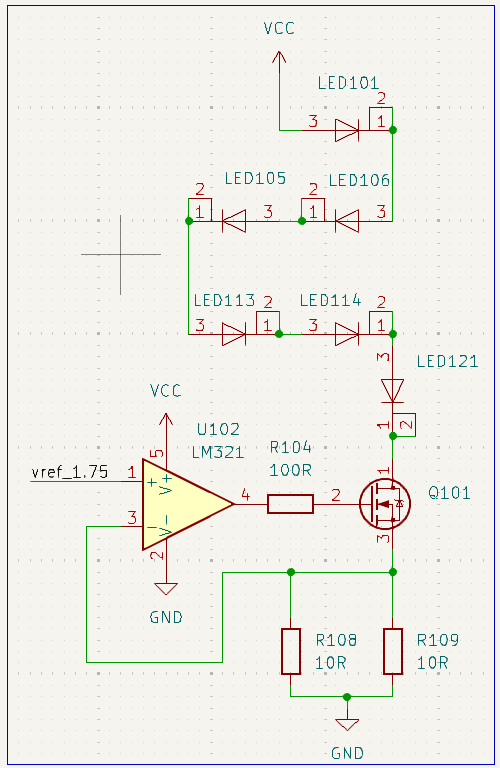
To achieve the 1.75V drop across the load resistors we
need the positive input reference to the opamp to be a nice stable
1.75V. Unfortunately there’s no easy and convenient Zener
diode, but we can use a chip from TI: LM4041. Slightly more
expensive, but we only need one in the circuit, so that’s fine.
This does need some setting resistors… Diagram from the datasheet: 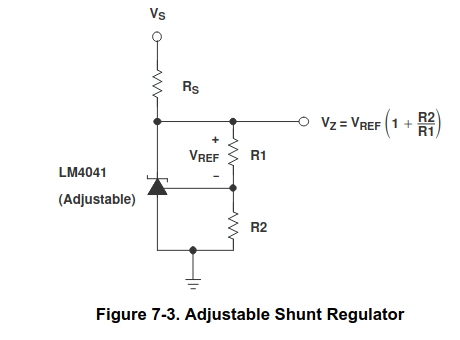
For 1.75V we’ll need a ratio of
R1/R2=0.429. Which resistors to use? Well thankfully
htere’s a website for that: jansson.us 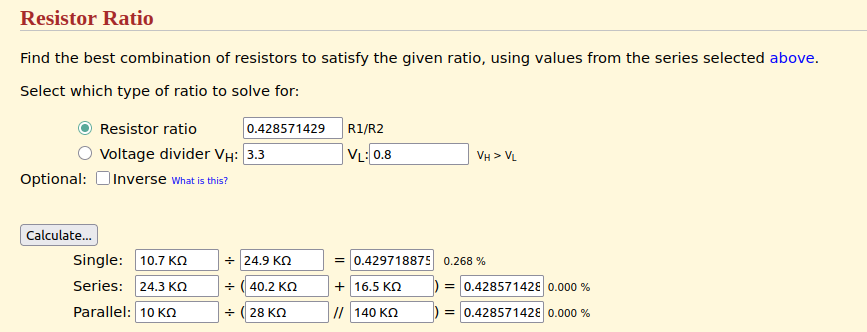
The other requirement for the LM4041 is
I(Rs)>80uA. At 17.75V that means
Rs < 221kR. With nothing better to put in,
a 100k will be sufficient.
Opamp requirements are pretty minimal. We’re hoping we don’t hit any stability problems, but if we have them then it’ll be a fun investigation. LM312 looks suitable.
The culminated design is here: led-bleacher.pdf
That was designed and manufacturing files were generated. Although layout took about as much time (or slightly more) and does take some finagling, it’s not as interesting (to me) to talk about3.
Unfortunately the LED’s I’d picked were a tad unusual, and although in the LCSC stocks, were not on the JLC books4, and I was very much intending for someone else to asemble these boards5.
This minor oversight brought the whole thing crashing down.
Full re-design and re-work would be required, because although ideas could be re-used, selecting and adjusting all the components would likely require a complete re-layout of the board.
The other option would be to invest in a hotplate and get some solder paste and all that, however I took this as an opportunity not to fall into the sunk cost trap.
If you have the capability and want to build it, feel free. The design files are here:
That said, please do something interesting with the silkscreen on the rear.